

Medically reviewed by Dr. Shuchi Singla, MBBS, MD (Dermatology) on 07 september, 2026
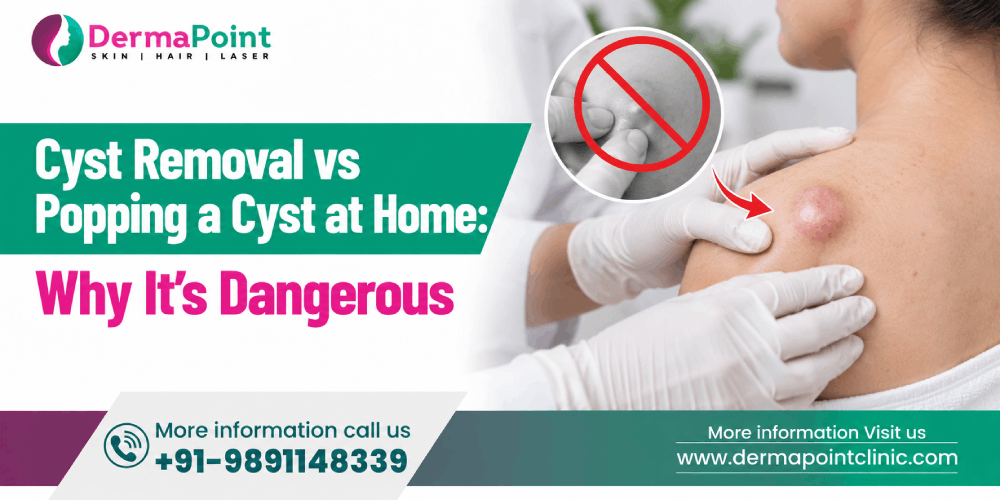
The discovery of a small bump or lump beneath the skin is a cause for concern, especially if it becomes painful, swollen or visible. A lot of people are tempted to puncture, squeeze, or even pop the cyst at home to eliminate it fast. What may appear to be a straightforward solution could increase the risk of infection, inflammation, scarring, and recurrence.
Understanding the distinction between professional Cyst removal and attempting to remove an unintentional cyst on your own is crucial for protecting your skin and avoiding complications.
According to Dr. Shuchi Singla, dermatologist at Dermapoint Clinic, Gurgaon, skin lumps must be assessed prior to attempting any type of removal. Dermapoint Clinic lists dermatosurgical procedures such as cyst excision, which makes the use of a professional evaluation an essential aspect of managing cysts safely.
What Is a Skin Cyst?
Skin cysts are lump-like sacs that form beneath the skin. There are various types of cysts, and not every lump that appears like a cyst will necessarily be identical.
Epidermoid cysts can be found in the neck, face, and even the trunk. They may be relatively small and not painful, but could become inflamed, tender or infected. There may also be tiny openings on the surface that release an unpleasant, thick substance.
Since different kinds of lumps may appear alike, it’s better to consult a dermatologist about the new, shifting or painful lump, rather than thinking that it’s a cyst.
Why Do People Try Popping a Cyst at Home?
The desire to try Cyst Popping at home typically is due to the desire for immediate relief. A cyst can feel like a pimple, especially when it’s enlarged or has an open area.
You can try squeezing the contents with your fingers, with a needle, or making a tiny cut to let the contents out.
The issue with cysts is the fact that it can’t be just a pimple that is visible. The substance is hidden within the cyst’s wall beneath the skin. Just releasing the contents does not mean that you will remove the wall.
The cyst could recur, and the added trauma or pressure could trigger bleeding, inflammation or even scarring.
Why Is Popping a Cyst at Home Dangerous?
1. It Can Cause an Infection
One of the most significant problems with home cyst popping is the possibility of infection. Needles, hands, pins and other household items can cause infection in the area.
The NHS specifically warns against squeezing the skin cyst, as when it bursts it could become infected or spread an infection.
When an infection is present, the affected area can appear redder, more tender, swollen or begin to produce pus. In certain instances, further medical intervention may be required.
2. It Can Increase Inflammation
In the process of forcing the contents out may irritate the tissue around it. An area of the cyst that appeared tiny and painless could be more painful and inflamed after repeated squeezes.
A cyst that is inflamed may be more difficult to get rid of. Mayo Clinic notes that an epidermoid cyst with inflammation could be more difficult to eliminate, and treatment could be delayed until inflammation subsides.
3. It May Leave a Scar
The repeated squeezing, cutting or puncturing may cause injury to surrounding skin. This could increase the likelihood of having visible marks, especially in the case of a cyst that is near the skin or other prominent region.
A cyst that you are trying to get rid of with a lot of force at home could transform a minor skin problem into a more long-term cosmetic issue.
Cyst Removal by Dermatologist: What to Expect
The process of removing cysts by dermatologists begins by examining the lump. The dermatologist will look at its appearance, location, signs, and whether it is inflamed or infected.
If treatment is needed, the most appropriate treatment method is dependent on the specific cyst.
In the case of some cysts, dermatologists may recommend a test to determine the cyst to determine if it is causing discomfort or other issues. In other cases, the possibility of treatment is due to the fact that this cyst causes pain, is constantly inflamed, infected, or rupturing or is irritating due to its appearance.
In the case of a condition, the options include medication to treat inflammation as well as surgical excision.
When Should You See a Dermatologist?
You should think about seeing a dermatologist in the following situations:
- The lump is expanding rapidly.
- It can be painful or tender.
- The surrounding skin turns pink or swollen.
- The cyst is constantly recurring.
- It opens up or begins draining.
- It is not clear if the lump is an actual cyst.
- The lump is situated on the skin, which is sensitive.
Finding the correct diagnosis is a crucial first step, as different types of skin lumps can require different treatment.
Conclusion
A cyst might look like a normal pimple. However, trying to treat it yourself can cause more issues than it resolves. Injuring or squeezing an area of the cyst may increase the chance of inflammation, infection, scarring and the possibility of recurrence.
Professional Cyst Removal begins by determining what the cyst is, and then determining if the treatment is required. Based on the type of cyst, a dermatologist could suggest observation, drainage or complete removal.
If you’ve noticed a persistent, painful, growing or recurring lump, do not attempt to eliminate it yourself. Consult a doctor. Shuchi Singla at Dermapoint Clinic, Gurgaon, can help you identify the problem and determine the best treatment plan.
In the case of skin lumps, a safe diagnosis and expert treatment is preferable to an easy fix at home.
Frequently Asked Questions
1. Can you safely open a cyst at home?
No. Puncturing or squeezing an acne cyst at home may increase the risk of inflammation, infection, scarring, and recurrence.
2. Does a cyst get rid of itself if I squeeze it?
It is possible to squeeze out some of the substance, but it isn’t a guarantee that the cyst’s wall will be eliminated. In the end, the cyst could return.
3. Can a dermatologist remove a cyst?
Yes. It depends on the type and size of your cyst; dermatologists could recommend a drainage procedure or surgical removal.
4. Do cyst removals leave a mark?
Any surgical procedure that involves an incision may create a mark. The appearance of the scar will depend on factors like the size of the cyst, its area, inflammation, the method used, as well as your own healing.
5. When should I visit an ophthalmologist for an infection?
Contact a medical professional when the lump is becoming larger, infected, painful, constantly growing, breaking out, or if you’re not sure whether the lump is an actual cyst.